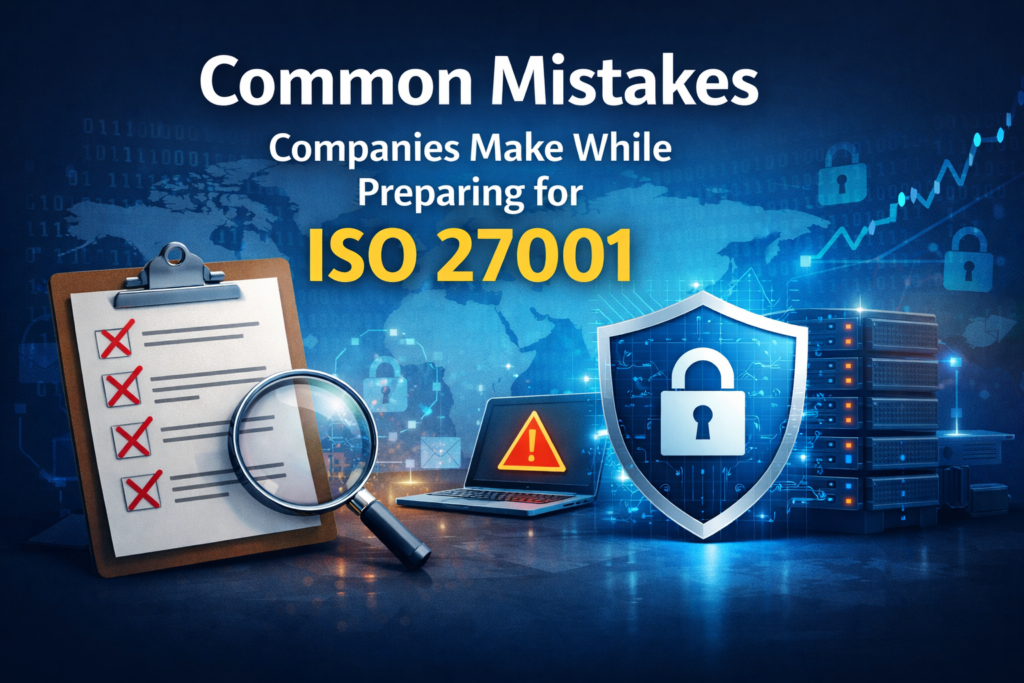
Common Mistakes Companies Make While Preparing for ISO 27001
Common Mistakes Companies Make While Preparing for ISO 27001
ISO 27001 certification has become a key trust signal for businesses handling data, cloud infrastructure, and digital operations. Yet, many organizations struggle during preparation — not because ISO 27001 is difficult, but because they approach it the wrong way.
As someone now directly involved in audit and certification readiness, I’ve seen repeating patterns that delay certification, increase costs, or lead to audit non-conformities.
This blog highlights the most common mistakes companies make while preparing for ISO 27001 — so you can avoid them from the start.
Mistake 1: Treating ISO 27001 as a Documentation Project
Many companies believe ISO 27001 is about writing policies and creating files.
In reality, ISO 27001 is about building a living Information Security Management System (ISMS). Documentation supports the system — it is not the system itself.
When processes don’t match written policies, audits fail.
Mistake 2: Skipping Proper Risk Assessment
Risk assessment is the foundation of ISO 27001.
Common issues include:
-
Copy-paste risk registers
-
No real asset identification
-
Risks not linked to business operations
Without a realistic risk assessment, security controls become meaningless on paper.
Mistake 3: Implementing Controls Without Business Context
Some organizations try to apply every Annex A control blindly.
ISO 27001 requires:
-
Selecting controls based on actual risks
-
Justifying exclusions
-
Aligning controls with business operations
Over-implementing unnecessary controls increases complexity without improving security.
Mistake 4: Ignoring Employee Awareness
Even the strongest policies fail if employees don’t understand them.
Auditors frequently check:
-
Security awareness training
-
Incident reporting knowledge
-
Day-to-day data handling practices
A security-aware team is one of the strongest audit advantages.
Mistake 5: Lack of Evidence and Records
Processes must leave evidence.
Auditors expect:
-
Logs and monitoring records
-
Training attendance records
-
Incident reports
-
Internal audit records
If activities happen but leave no records, it counts as non-conformity.
Mistake 6: Treating Certification as a One-Time Event
ISO 27001 is based on continual improvement.
Companies often fail to:
-
Conduct internal audits regularly
-
Review management reports
-
Update risk assessments periodically
Auditors look for ongoing maturity — not one-time preparation.
A Simple ISO 27001 Readiness Check
Before starting certification, ask yourself:
✔ Do we have a real risk assessment?
✔ Are security controls operating in daily work?
✔ Do employees understand security responsibilities?
✔ Do we maintain security evidence records?
✔ Do we conduct internal reviews regularly?
If any answer is “No”, preparation needs strengthening.
How HEyeOne Helps
At HEyeOne, we help businesses build practical, audit-ready ISMS frameworks — from risk assessment and documentation to training, internal audits, and certification readiness.
Our goal is simple:
Make ISO 27001 achievable without confusion or wasted effort.
Final Thought
ISO 27001 success is not about paperwork.
It is about building disciplined security practices that auditors can trust and businesses can rely on.