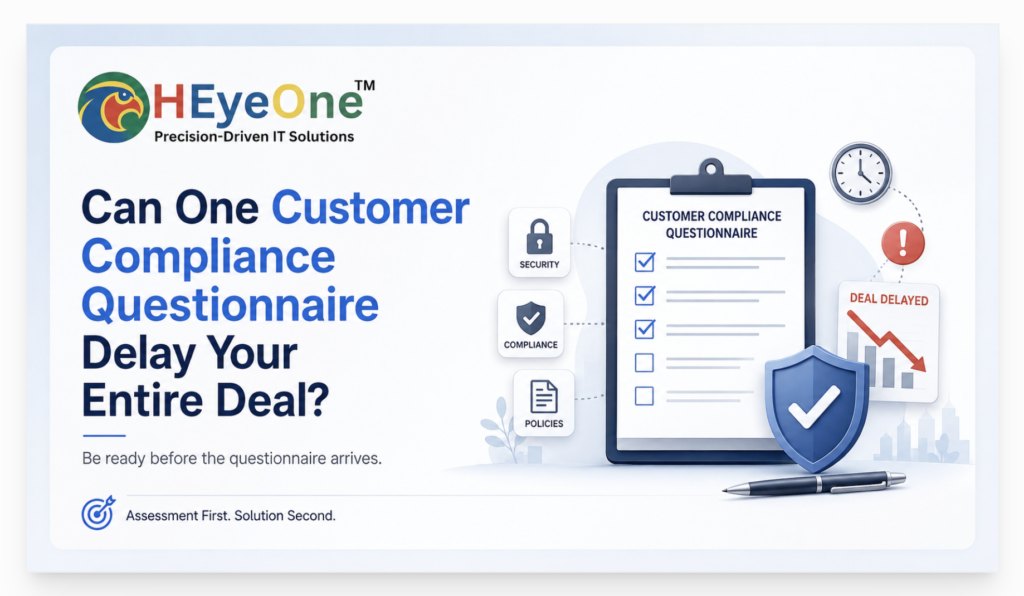
Can One Customer Compliance Questionnaire Delay Your Entire Deal?
🗓️August 24, 2026
·
🕐 4 min read
Winning a new customer is exciting.
But for many growing businesses, the real challenge begins after the commercial discussion is almost done.
A serious enterprise customer may suddenly send a detailed compliance or security questionnaire asking for things such as:
- Information security policies
- Access control practices
- Data backup and recovery
- Employee responsibilities
- Vendor management
- Incident response
- Business continuity
- Certifications such as ISO 27001 or ISO 9001
- Evidence that your processes are actually being followed
At that point, a deal that looked close to completion can slow down for days or even weeks.
The problem is usually not that the business has done nothing.
The problem is that the required information is scattered, undocumented, outdated or difficult to prove quickly.
Why Customer Questionnaires Become a Problem
As businesses grow, customers start expecting more than a good product or service.
They want confidence that your business can operate in a structured, secure and reliable way.
A questionnaire may ask simple-looking questions such as:
Who can access customer data?
How are employees given or removed access?
How often are backups reviewed?
What happens if there is a security incident?
Do you assess your suppliers or service providers?
The difficulty begins when the answers depend on one person’s memory, old email conversations or documents that were created only for a previous audit.
That is when the questionnaire becomes a business delay instead of a routine review.
The Real Issue Is Evidence Readiness
Many businesses already follow good practices informally.
For example:
- Access may be restricted to selected employees
- Backups may already be running
- Employees may already receive basic instructions
- Customer information may already be handled carefully
- Critical suppliers may already be reviewed before selection
But when a customer asks for proof, the business may struggle to produce:
- Approved policies
- Responsibility records
- Access reviews
- Training evidence
- Backup logs
- Review records
- Risk assessments
- Incident procedures
This is where evidence readiness becomes important.
Good compliance is not only about having a policy.
It is about being able to show that the policy is understood, followed and reviewed.
A Customer Questionnaire Can Affect More Than Compliance
A delayed questionnaire can affect several parts of the sales process.
1. Commercial Closure
The customer may be ready to proceed commercially, but procurement or compliance approval may still be pending.
2. Customer Confidence
Unclear or inconsistent answers can make a customer question whether the business is mature enough for a larger engagement.
3. Internal Time
Founders, IT teams, operations teams and finance teams may spend several days searching for documents and preparing responses at the last moment.
4. Future Opportunities
The same problem can repeat with every larger customer unless the business creates a reusable compliance foundation.
What Should a Growing Business Prepare?
You do not need hundreds of documents.
Start with the areas most likely to be reviewed by customers.
Clear Policies
Maintain practical policies covering areas such as information security, access, backup, incident handling and acceptable use.
Defined Ownership
Every important process should have a clear owner.
Customers want to know not only what your business does, but also who is responsible for doing it.
Basic Evidence
Keep records that show important controls are actually working.
This may include access reviews, training records, approvals, logs or review checklists.
Regular Review
Policies and procedures should not remain unchanged for years.
Review them periodically as your team, technology and customer requirements change.
Certification Where Relevant
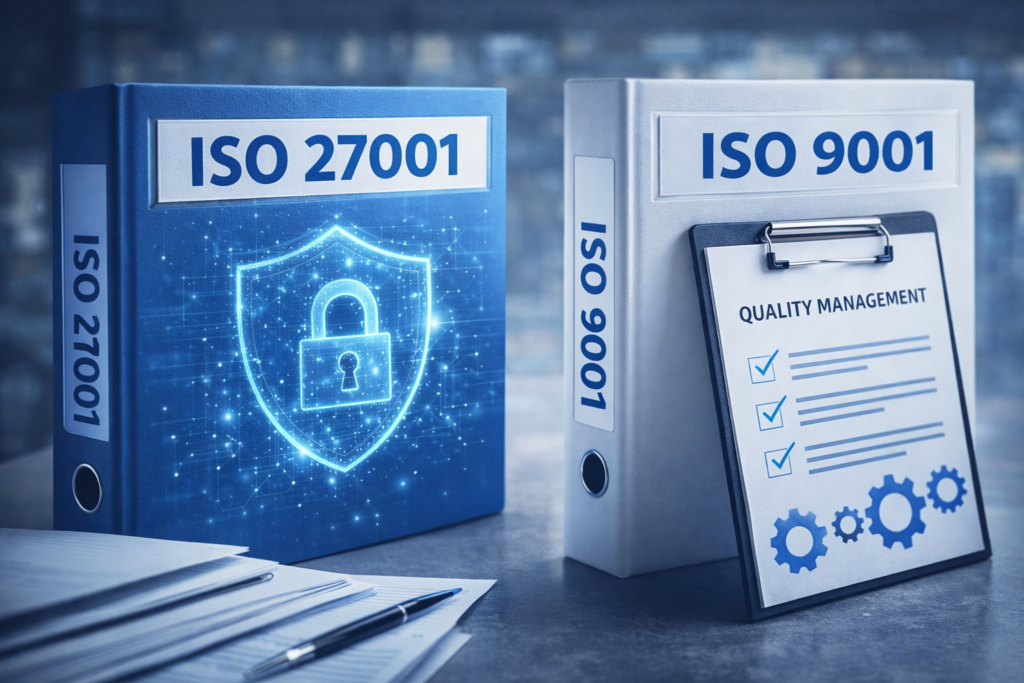
Standards such as ISO 27001 and ISO 9001 can help businesses build a more structured compliance foundation when they are relevant to the organisation and its customers.
The goal should not be certification only.
The goal should be stronger day-to-day operations and easier customer assurance.
Assessment First. Solution Second.
Before creating dozens of policies or rushing toward a certification, first understand what your customers are actually asking for.
A practical readiness review can help identify:
- Which documents already exist
- Which controls are already working
- Where evidence is missing
- Which gaps could delay customer approval
- Whether a formal standard or certification would add value
This helps the business invest effort where it matters most.
Be Ready Before the Questionnaire Arrives
Compliance should not start when a customer sends a 100-question spreadsheet.
A business that keeps its policies, responsibilities and evidence organised can respond faster and with greater confidence.
That can make the difference between a compliance questionnaire becoming a minor review step or a major delay in closing the deal.
At HEyeOne, we help businesses review their compliance readiness, identify practical gaps and build the documentation and processes needed to support stronger customer conversations.
Assessment First. Solution Second.
Ready to review your compliance readiness?
Contact HEyeOne:
https://heyeone.com/contact/
HEyeOne Private Limited
Secure | Compliant | Enterprise-Ready