

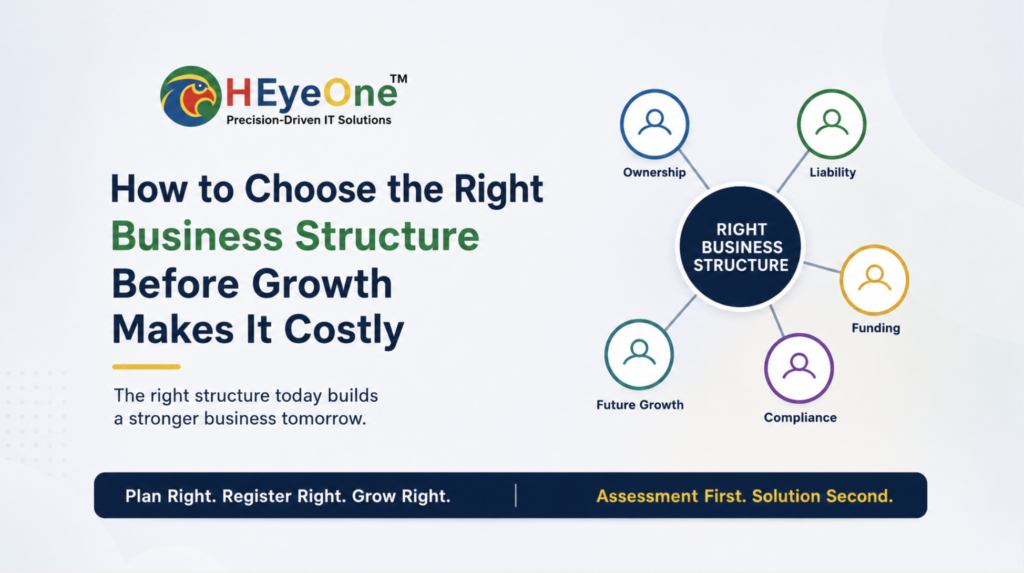
How to Choose the Right Business Structure Before Growth Makes It Costly
Starting a business often begins with a practical question:
“Which registration can be completed quickly and economically?”
That question is understandable, but it is not enough.
A business structure should not be selected only on the basis of registration cost or the number of documents required today. It should also support the way the business intends to operate, add partners, manage responsibility, approach customers, raise funds and grow in the future.
Choosing a structure that works only for the present can create unnecessary complications later.
A Business Structure Is More Than a Registration Certificate
Your business structure influences several important areas, including:
- Who legally owns the business
- How responsibilities are divided
- Whether personal and business liabilities are separated
- How new partners or investors may be added
- The level of ongoing compliance
- How profits can be withdrawn or distributed
- How easily ownership can change
- How customers, banks and potential partners may evaluate the organisation
Startup India also identifies taxation, owner liability, compliance burden, funding and exit strategy as important factors when selecting a business entity.
This is why two businesses offering similar services may still require completely different legal structures.
Why the Cheapest Option Can Become Expensive Later
A small business may begin informally because it appears easier to manage.
However, problems can arise when the business starts growing.
For example:
- A new co-founder may need to be added
- A large customer may ask for formal company documents
- The business may want to raise investment
- Ownership percentages may need to be clearly defined
- Personal and business finances may become difficult to separate
- Contracts may require a recognised legal entity
- The founders may disagree about roles, investments or profit sharing
- The existing structure may no longer support the business model
At that stage, changing the structure can involve fresh registrations, revised agreements, changes in banking and invoicing, transfer of contracts, accounting adjustments and communication with customers or vendors.
The original saving may then become a larger operational cost.
The Main Structures Businesses Commonly Consider
There is no single structure that is best for every business. The correct choice depends on the number of owners, the nature of the activity, future plans and the level of responsibility the owners are prepared to manage.
Sole Proprietorship
A sole proprietorship may suit an individual starting a small, owner-managed business with limited operational complexity.
It is generally easier to begin, but the business does not have a separate legal identity from its owner. The proprietor is personally responsible for the obligations of the business.
It may be suitable when:
- There is only one owner
- The operations are small and straightforward
- External investment is not planned
- Business exposure is limited
- The owner wants a simple initial setup
However, it may become limiting when the business needs additional owners, greater separation between personal and business responsibility, or a more scalable ownership structure.
Partnership Firm
A partnership allows two or more people to operate a business according to an agreed partnership arrangement.
It may work for a closely held business where the partners have clearly defined roles and a strong understanding of how profits, decisions and responsibilities will be shared.
A written partnership deed should clearly address:
- Capital contribution
- Profit-sharing ratio
- Roles and responsibilities
- Decision-making authority
- Addition or retirement of partners
- Dispute resolution
- Exit conditions
In a general partnership, partners may have personal liability for business obligations. This factor should be carefully understood before choosing the structure.
Limited Liability Partnership
A Limited Liability Partnership, or LLP, combines a partnership-style operating model with limited liability for its partners.
It may be suitable for professional services, consulting firms, agencies and businesses with two or more owners that want formal ownership without necessarily planning to raise equity investment.
An LLP may be considered when:
- Two or more partners will manage the business
- Roles and profit sharing need to be formally documented
- Limited liability is important
- External equity investment is not an immediate priority
- The partners prefer a partnership-oriented management structure
The LLP agreement becomes a critical document because it defines how the business will be governed and how the relationship between partners will work.
Private Limited Company
A Private Limited Company may be more suitable for a business that intends to scale, add shareholders, raise external funding, create a formal governance structure or build a company that can operate independently of its original founders.
It may be considered when:
- The business has multiple founders or shareholders
- Equity investment may be required
- Ownership may change over time
- Employee stock options may be considered
- Larger customers or partners expect a formal corporate structure
- The founders are prepared for greater ongoing compliance
Startup India notes that growing companies often choose the Private Limited structure because it can accommodate outside investment, offer limited liability and support employee stock options. It also carries greater compliance responsibilities.
One Person Company
A One Person Company, or OPC, provides a company structure for a single promoter.
It may suit a solo entrepreneur who wants limited liability and a separate legal entity but does not currently have another shareholder.
However, the founder should still evaluate whether the OPC structure will support future plans, especially if additional shareholders or external investment may be required later.
Five Questions to Ask Before Registering
Before selecting a structure, founders should discuss these five questions clearly.
1. Who Will Own the Business?
Consider not only the current owners but also whether another partner, family member, investor or senior employee may receive ownership later.
The structure should make ownership clear and manageable.
2. What Level of Personal Liability Is Acceptable?
Some structures do not separate the owner from the business in the same way as an LLP or company.
The nature of contracts, borrowing, customer commitments and operational exposure should be considered before making this decision.
3. Will the Business Need Investment?
A business planning to raise equity investment requires a structure that can practically accommodate investors and changes in shareholding.
The easiest structure to start may not be the easiest structure through which to raise capital.
4. How Much Compliance Can the Business Manage?
Formal structures bring credibility and continuity, but they also bring responsibilities.
The founders should understand the likely requirements related to accounting, annual filings, meetings, records, agreements and statutory compliance.
A structure should not be chosen merely for prestige if the business is not prepared to maintain it properly.
5. What Should the Business Look Like Three Years From Now?
Founders should think beyond the first invoice.
Ask:
- Will the business remain owner-operated?
- Will it add partners or shareholders?
- Will it serve enterprise customers?
- Will it operate in multiple locations?
- Will it build a team?
- Will it seek investment?
- Will the founders eventually sell or transfer ownership?
The answers can significantly influence the right structure.
Registration Should Follow the Business Plan
The correct sequence is not:
Select a registration first and adjust the business later.
A better sequence is:
- Understand the business model
- Clarify ownership and responsibilities
- Consider liability and compliance
- Review funding and growth plans
- Select the most suitable structure
- Complete the required registrations and operational setup
This is the difference between simply registering a business and building the right foundation for it.
The Right Structure Is the One That Supports the Next Stage
A proprietorship is not automatically too small.
An LLP is not automatically better than a company.
A Private Limited Company is not automatically the best choice for every founder.
Each structure has a purpose.
The right decision depends on where the business is today, what responsibilities it carries and where the founders want to take it.
Registration should therefore be approached as a business decision—not merely a documentation exercise.
Assessment First. Solution Second.
At HEyeOne, we first understand the business model, ownership plan, operational requirements and future direction. Based on that understanding, we help identify the appropriate registration and business setup requirements.
The objective is not simply to complete a registration.
The objective is to establish a foundation that supports the business as it grows.
Planning to start a business or reconsider your existing structure?
Book a discussion with HEyeOne: https://heyeone.com/contact/
Disclaimer: This article provides general business information and should not be treated as legal, tax or financial advice. The appropriate structure and applicable requirements should be confirmed with qualified professionals based on the specific circumstances of the business.